Book of the Day
The Guide
R.K. Narayan · 1958
His first novel was going nowhere in London until a friend at Oxford put it in front of Graham Greene — who found him a publisher and told him to shorten his name.
The Guide
R.K. Narayan · 1958
A friend at Oxford
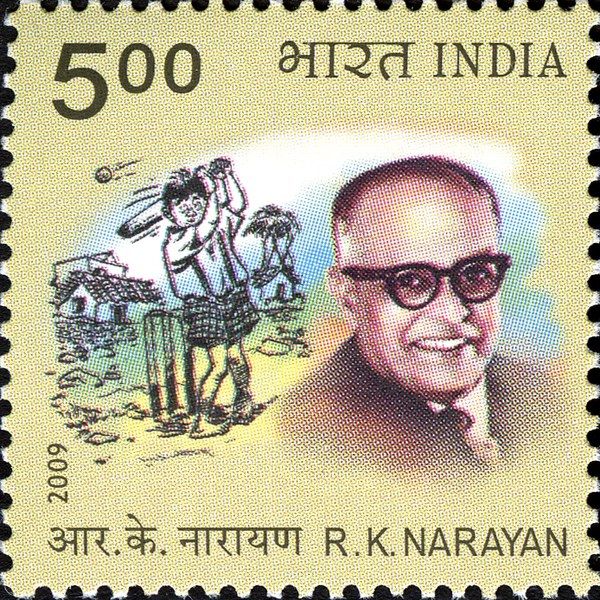
Narayan's first novel, Swami and Friends, was written in Mysore and had no obvious route to a publisher. He sent the manuscript to a friend at Oxford.
That friend showed it to Graham Greene, then a young novelist with a growing reputation. Greene read it, thought it remarkable, and took it upon himself to place it with a serious English publisher — Hamish Hamilton, who brought it out in 1935.
Greene gave him one other piece of advice, which is why nobody outside his family ever used his full name. Rasipuram Krishnaswami Ayyar Narayanswami became R.K. Narayan, on the grounds that English readers would manage it.
They corresponded for decades, and Greene championed him for the rest of his life.
Malgudi
Narayan then spent a career writing about a single invented South Indian town. Malgudi has a railway station, a river, a market, a school, and a population of ordinary people getting things slightly wrong.
The style is the most easily underrated thing about him: plain, unhurried English sentences with no visible effort in them, and no explanation offered to foreign readers. Greene compared him to Chekhov. Others have found him too gentle. Both readings survive contact with the books.
The book
The Guide is his best-known novel, and it is sharper than his reputation suggests.
Raju is a railway-station tour guide who talks his way into things — an affair with a dancer, a career managing her, then forgery and prison. Released, he sits in a ruined temple because he has nowhere else to go, and villagers mistake him for a holy man. He accepts the food and the deference. Then a drought comes, and the villagers become convinced that if the swami fasts, it will rain.
The book ends with a fraud fasting for a village that believes in him, unable to confess without destroying them, and no clear answer as to whether the rain comes or whether he has become the thing he was pretending to be.
It won the Sahitya Akademi Award in 1960.
On screen
The 1965 Hindi film Guide, directed by Vijay Anand and starring Dev Anand and Waheeda Rehman, is regarded as one of the finest Indian films ever made — with S.D. Burman's music among the most loved of the era.
Narayan disliked it. He wrote publicly about the experience, unhappy at how his novel had been changed for the screen, in one of the more entertaining author-versus-film accounts on record.
A separate English-language version was made at the same time with American involvement, and is largely forgotten.
Why it still matters
Narayan, Raja Rao and Mulk Raj Anand are usually named as the writers who established Indian fiction in English. Narayan's particular contribution was proving that it did not require grandeur. A small town, ordinary disappointments, plain sentences — and no apology, no glossary, no translating himself for anyone.
He died in 2001, aged 94.
Where this stands
All twenty are drafted. Seven have had claims checked (entries 1, 4, 5, 6, 7 carry sources; see the status table at the top). Thirteen are marked verification pending and must not be published in that state.
### What happens next
1. Verification pass. Every claim in entries 2, 3, 8–20 gets a source or gets cut. That is the slow part, and it is not optional. 2. Image sourcing. Each photo slot names an image; each one needs its licence confirmed. Public-domain portraits and pre-1930 title pages are straightforward. Modern book jackets are not — for those I'd link to an Open Library cover rather than reproduce the artwork. 3. Then the code: `BookOfTheDay` table, admin editor, `/book-of-the-day/[slug]` pages, and the cards on `/news` and the landing page.
### Known weak points, stated plainly
- The Lincoln quotation in Uncle Tom's Cabin is included as a debunk. If it gets quoted approvingly anywhere, that entry has failed. - Rushdie's advertising agency is named in most accounts but I have not confirmed which one. It stays unnamed until I have. - Who left Tagore's briefcase on the Underground differs between accounts. - Cervantes's excommunication and the five publishers who rejected Sinclair are both widely repeated and both need a primary-ish source. - Several sales figures (fifty million, forty million, half a billion) come from publishers and are not independently audited. Worth phrasing as "reported".
Did you know
- A friend at Oxford showed the manuscript to Graham Greene, who placed it with Hamish Hamilton in 1935. ✓
- Greene told him to shorten his name — Rasipuram Krishnaswami Ayyar Narayanswami became R.K. Narayan. ✓
- The Thames story is not included: widely repeated, but I could not source it.
- Malgudi is invented, and people still argue about which real town it is.
- The Guide won the Sahitya Akademi Award in 1960.
- The 1965 film is a classic — and Narayan disliked it, publicly.
- He wrote about Malgudi for more than fifty years.
Is this book on a shelf near you?
BookHome is a neighbourhood book exchange. See who nearby has a copy to lend, swap or sell.