Book of the Day
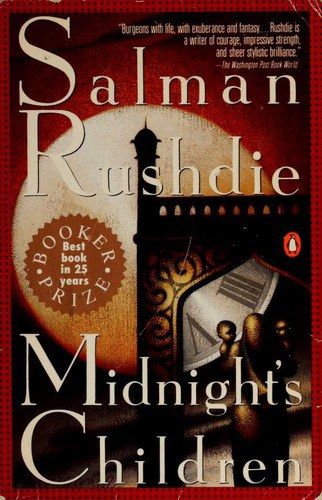
Midnight's Children
Salman Rushdie · 1981
He wrote it in the evenings, while working at Ogilvy & Mather writing slogans for chocolate bars and cream cakes.

The day job
Before he was a novelist, Rushdie wrote advertising copy at Ogilvy & Mather. He was good at it. He is credited with "irresistibubble" for Aero and "Naughty but Nice" for cream cakes — lines that outlived most of the campaigns around them.
He needed the money. His first novel, Grimus, had gone almost unnoticed. So Midnight's Children was written the way most first serious novels actually are: in the evenings and at weekends, by someone who had been at work all day. He was still at Ogilvy while he wrote it.
A boy born at midnight
The book's premise is a gift: Saleem Sinai is born at the exact stroke of midnight on 15 August 1947, the moment of Indian independence, and is therefore handcuffed to history. Every child born in that first hour has a power. Saleem's is a nose that can smell emotions, and a telepathic link to all the others.
What makes it work is that the fantasy is never an escape from the history. Partition, the Emergency, the wars — they arrive with full force, and the magic makes them harder to look away from rather than easier.
Three Bookers
It won the Booker Prize in 1981.
Then the Booker went back and judged its own history twice — at the twenty-fifth anniversary and again at the fortieth — and both times Midnight's Children was named the best of every winner the prize had ever given.
No other novel has done that.
The lawsuit
Indira Gandhi brought a defamation case over the book.
It is a strange footnote: a novel about the Emergency, in which a serving Prime Minister appears as a character, was challenged in court by that Prime Minister.
On screen
Deepa Mehta filmed it in 2012, with Rushdie writing the screenplay and narrating. Production was complicated by political pressure — Sri Lanka, where much of it was shot, briefly withdrew permissions after objections. Reviews were mixed. The consensus is roughly that the novel's method does not survive being made literal.
Why it still matters
Its influence on Indian writing in English is difficult to overstate. It made it possible to write English that sounded like the way people in India actually spoke it — crowded, punning, unembarrassed — rather than a careful imitation of London.
Rushdie later described the goal as "chutnification": taking the language of the coloniser and pickling it until it tasted of somewhere else.
Did you know
- He wrote it while working at Ogilvy & Mather as a copywriter. ✓
- He is credited with "irresistibubble" for Aero and "Naughty but Nice" for cream cakes. ✓
- Booker Prize 1981 ✓ — then judged the best of all winners at both the twenty-fifth and fortieth anniversaries. ✓
- Indira Gandhi brought a defamation case over it. ✓
Is this book on a shelf near you?
BookHome is a neighbourhood book exchange. See who nearby has a copy to lend, swap or sell.