Book of the Day
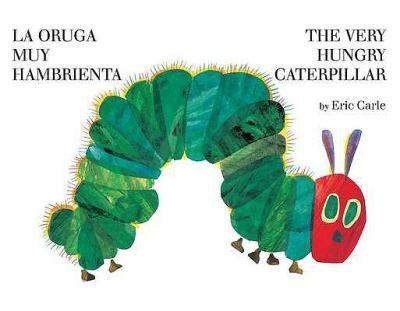
The Very Hungry Caterpillar
Eric Carle · 1969
It began as a book about a worm, and only became a caterpillar because an editor said so — which is the only reason it has a butterfly at the end.

A hole punch
Carle was working as a graphic designer and idly punching holes in a stack of paper when he thought of a bookworm eating its way through the pages. He drafted a story about it and called it A Week with Willi the Worm.
He took the mock-up to his editor, Ann Beneduce. She did not think much of the worm and suggested a character with a more dramatic journey.
By Carle's account the whole thing turned on two words. She said: "Caterpillar?" He said: "Butterfly!"
That single change is why the book works. A worm eats through a week and is still a worm. A caterpillar eats through a week and becomes something else — and the whole book acquires an ending, a transformation, and a reason to exist beyond counting food. One editorial note turned an idea into one of the best-selling children's books ever published.
The holes nobody would print
The die-cut holes — different sizes, in the middle of pages of different widths — were a manufacturing problem. American printers of the period were not set up for it, or would not take it on at a price that made the book viable.
Beneduce took the project to Japan, where the engineers at Kaisei-sha in Tokyo worked out how to print and align the die-cut holes and the shortened pages that became the book's signature.
The result is a book that a small child can put a finger through. That is not decoration: for a child too young to read, the holes are the part they can operate themselves.
The childhood behind it
The brightness of Carle's work is not incidental, and it is not naivety.
He was born in New York to German parents and taken back to Germany as a small child, where he spent the war. As a teenager he was conscripted to dig trenches on the Siegfried Line. His father was drafted into the German army, captured by the Soviets, and returned years later so reduced by the experience that Carle described him as a broken man.
Carle said that the wartime Germany of his childhood was grey — buildings painted grey and brown as camouflage, everything muted — and that he had a memory of a teacher quietly showing him forbidden modern paintings, full of colour, which stayed with him.
The tissue-paper collage, the loud colour, the sun with a face: those are a deliberate answer to a grey childhood.
Why it still matters
It has sold well over fifty million copies and been translated into more than sixty languages, and for a very large number of people worldwide it is the first book they ever held.
It also does several things at once without announcing any of them: counting, days of the week, the idea that eating too much makes you unwell, and a transformation at the end that a two-year-old can follow. It is a much more carefully engineered object than it appears.
Did you know
- It started as a mock-up called "A Week with Willi Worm", inspired by a hole punch in his studio. ✓
- The editor said "Caterpillar?" and Carle said "Butterfly!" — that exchange is the entire book. ✓
- No American printer would take on the die-cut holes affordably; it was printed by Kaisei-sha in Tokyo. ✓
- Carle was conscripted as a teenager to dig trenches in wartime Germany.
- His father returned from Soviet captivity years after the war, badly broken.
- Over fifty million copies, in more than sixty languages.
Is this book on a shelf near you?
BookHome is a neighbourhood book exchange. See who nearby has a copy to lend, swap or sell.