Book of the Day
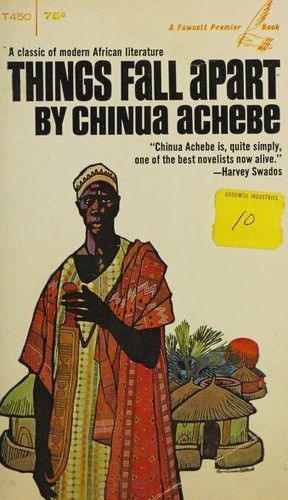
Things Fall Apart
Chinua Achebe · 1958
The only copy in existence sat ignored in a London office for months, while its author wrote letters that nobody answered.
Written against a library
Achebe grew up in Ogidi, in south-eastern Nigeria, and was educated in English, in a colonial school system, on English books. He read the adventure novels set in Africa that English schoolboys read — and, as he described it later, read them from the side of the white characters, because that was the only position the books offered. It took him years to notice that he was not who those authors had in mind.
The turning point came at university, reading Joyce Cary's Mister Johnson, a novel set in Nigeria and much admired in England. Achebe found its Nigerian characters grotesque. He decided that the only way to answer a library was to write a book.
He was working at the Nigerian Broadcasting Service. He wrote it in his own time.
The manuscript that went missing
When it was finished he had one handwritten copy. He answered an advertisement in The Spectator from a London typing agency, posted the manuscript to England, and sent £22 in British postal orders — a serious sum for a young man on a Lagos salary — asking for two typed copies.
Nothing came back. He wrote. No reply. He wrote again. Silence. Months passed with the only existing copy of his novel sitting in an office in another country, belonging to people who had no particular reason to care.
It was rescued because he mentioned it to his boss at the broadcasting service, Angela Beattie, who was travelling to London on annual leave. She went to the agency in person and demanded to know what was going on. A typed copy was in the post to Lagos the following week. Without that visit there would be no Things Fall Apart, and the shape of African literature in English would be different.
What the book did
The novel follows Okonkwo, a wrestler and man of standing in an Igbo community, whose life is governed by his terror of being thought weak like his father — and whose world is then dismantled by the arrival of missionaries and colonial administration.
Its radical move was not anger. It was ordinariness. Achebe wrote a society with its own law, humour, poetry, cruelty and internal argument, functioning entirely on its own terms before any European appears. The reader has spent a hundred pages inside that world before the collapse begins, which means the collapse is felt as loss rather than observed as anthropology.
It has sold well over twenty million copies in more than fifty languages, and has never been out of print.
The lecture that started a fight
In 1975 Achebe delivered a lecture called "An Image of Africa", arguing that Joseph Conrad's Heart of Darkness — then untouchable, a fixture of every syllabus — was the work of, in his words, "a thoroughgoing racist", using Africa as a backdrop for a European crisis and denying Africans language.
The reaction was furious. Decades on, the argument is still running, and no serious discussion of Conrad now happens without it. Achebe changed not just what was written but how earlier books were read.
On screen
A Nigerian television adaptation in 1987, with Pete Edochie as Okonkwo, became one of the most-watched productions in the country's history and fixed the character's face in the national imagination. An earlier German-Nigerian film, Bullfrog in the Sun (1971), drew on it too.
Afterwards
A car accident in 1990 left Achebe paralysed from the waist down; he spent much of the rest of his life teaching in the United States. He twice declined a Nigerian national honour — in 2004 and again in 2011 — in protest at the condition of the country. He never received the Nobel Prize, which remains one of the more conspicuous omissions in the prize's history. He died in 2013.
Did you know
- He posted his only handwritten copy to London, with no duplicate anywhere, after answering an advert in The Spectator, and sent £22 in postal orders for two typed copies.
- It was recovered only because his boss, Angela Beattie, went to the typing agency in person while on annual leave in London.
- The title is a line from Yeats's "The Second Coming".
- Over twenty million copies, fifty-plus languages, and never out of print since 1958.
- His 1975 lecture on Conrad permanently changed how Heart of Darkness is taught.
- He turned down a Nigerian national honour twice, in 2004 and 2011.
Is this book on a shelf near you?
BookHome is a neighbourhood book exchange. See who nearby has a copy to lend, swap or sell.