Book of the Day
Don Quixote
Miguel de Cervantes · Part One 1605, Part Two 1615
Maimed at sea, enslaved for five years, jailed over a shortfall in his accounts — and then, in his late fifties, a failure by every measure wrote what many still call the first modern novel.
A soldier's hand
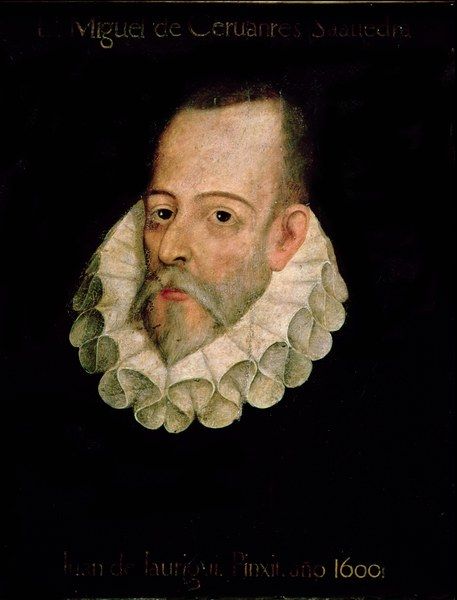
In 1571 Cervantes fought at Lepanto, one of the last great battles fought between oared galleys. He was below decks with a fever and insisted on being carried up to fight anyway. He took three gunshot wounds — two in the chest, one that permanently destroyed the use of his left hand.
He was proud of it for the rest of his life. He became known as el manco de Lepanto, the one-handed man of Lepanto, and said he would do it again. Keep that man in mind, because everything that follows happened to someone who did not give up easily.
Five years in Algiers
Sailing home in 1575, his ship was taken by Barbary corsairs. He was carrying letters of commendation from his commanders, which made his situation worse rather than better: the letters suggested he was a man of consequence, so his ransom was set high and he was held in Algiers for five years.
He attempted escape four times. Every attempt failed. By the surviving accounts he took sole responsibility each time rather than name the men who had helped him, which is likely why he was not executed for it. He was ransomed in 1580 by Trinitarian friars, using money his family had bankrupted itself raising.
He came home at thirty-three: a decorated veteran with a crippled hand, in a country that had no particular use for him.
The worst job in Spain
He tried the theatre and had modest success. He applied for a post in the Americas and was turned down. Eventually he took work as a commissary, requisitioning grain and oil for the Spanish Armada — which meant taking food from people who did not want to give it, including, on at least one occasion, from the Church. The dean and chapter of Seville Cathedral excommunicated him for requisitioning their grain at Écija. It was not a one-off: the Church excommunicated him three times over the course of that work.
Then he became a tax collector, which went worse. He was jailed in 1592 at Castro del Río, accused of selling wheat without authorisation. Then a banker holding public money he had collected went under, the accounts would not reconcile, and he was imprisoned again in Seville in 1597.
In his own prologue to Don Quixote he writes that the book was "engendered in a prison". That is his phrase, not a later legend. Whether he actually wrote pages there or only conceived it is unknown, and any version of the story that sounds certain is guessing.
The book, and the thief
Part One appeared in January 1605, when Cervantes was fifty-seven. It sold extraordinarily well and was pirated almost at once. He had signed away most of the rights, so it made him famous and left him poor — a combination he had by then had a great deal of practice at.
Then in 1614 someone else published a sequel. It appeared under the name Alonso Fernández de Avellaneda, and carried a preface mocking Cervantes for being old and one-handed. Nobody has ever established who wrote it.
Cervantes's answer was remarkable. He finished his own Part Two in 1615 and wrote the forgery into the story. His characters meet people who have read the fake. Don Quixote deliberately changes his route so that the impostor's account of where he went can be proved false. A novel about a man who cannot tell stories from reality absorbed a real literary theft into its plot and turned it into evidence.
He died in Madrid in April 1616.
Why it still matters
The claim that this is the first modern novel survives scrutiny better than most literary superlatives. It has interior life, an unreliable narrator, characters who are changed by what happens to them, and a running argument with its own existence as a book — in Part Two, the characters have read Part One and have opinions about it.
"Quixotic" entered English and stayed. So did tilting at windmills.
Did you know
- He lost the use of his left hand at Lepanto and regarded it as an honour.
- He was enslaved in Algiers for five years and attempted escape four times.
- He was imprisoned twice — Castro del Río in 1592, Seville in 1597. ✓
- The dean and chapter of Seville Cathedral excommunicated him over grain taken at Écija — and the Church excommunicated him three times in all. ✓
- His own prologue says the book was "engendered in a prison".
- A fake Part Two appeared in 1614, and Cervantes wrote its existence into his real Part Two as a plot device.
- He was fifty-seven when Part One appeared, after a lifetime of failure.
Is this book on a shelf near you?
BookHome is a neighbourhood book exchange. See who nearby has a copy to lend, swap or sell.