Book of the Day
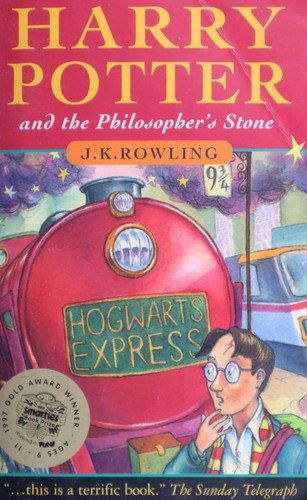
Harry Potter and the Philosopher's Stone
J.K. Rowling · 1997
Around twelve publishers turned it down. The one that said yes did so because the chairman's eight-year-old daughter came back downstairs demanding the next chapter.
Four hours on a delayed train
The idea arrived in 1990 on a delayed train between Manchester and London: a boy who does not know he is a wizard. She had no working pen and did not want to ask a stranger for one, so she sat for four hours and thought instead. By the time the train moved she had the school, the houses, and most of a cast.
The five years that followed were not a writing retreat. Her mother died. She moved abroad, married, had a daughter, and came back to Britain in 1993 as a single parent with an unfinished manuscript in a suitcase. She has described the period without decoration: as poor as it is possible to be in modern Britain without being homeless, living on state benefits.
She wrote in cafés — partly because getting her daughter to sleep meant walking her in a pram until she did, and partly because a café was warm. When it was finished she typed the manuscript herself on a manual typewriter, twice, because publishers wanted two copies and she could not afford photocopying.
The rejections
It went out and came back. Around a dozen publishers said no. One told her, kindly enough, to get a day job, because children's books do not make money.
At Bloomsbury, the chairman Nigel Newton took the sample home and handed the first chapter to his daughter Alice, who was eight. She came back down the stairs about an hour later and told him it was better than anything he had ever shown her — then, in his words, nagged him for months wanting to know what happened next.
Bloomsbury bought it for an advance of £2,500 and printed 500 hardbacks, along with a few thousand paperbacks.
They also asked her to publish under initials rather than her first name, on the theory that boys would not pick up a book they knew a woman had written. She has no middle name. The "K" was borrowed from her grandmother, Kathleen.
What happened next
The series has sold in the region of half a billion copies in more than eighty languages. Those first 500 hardbacks are now among the most valuable modern first editions in the world, reaching tens of thousands of pounds at auction.
The eight films made between 2001 and 2011 became one of the highest-grossing series ever, and kept a generation of British studios, crews and effects houses in continuous work for a decade.
Why it still matters
Publishing is full of rejection stories, and most are told to flatter whoever turned out to be right. This one is more useful, because the rejections were not stupid.
A long children's book by an unknown writer, set in a boarding school, at a time when children's publishing was contracting, genuinely was a poor commercial bet. The editors were reasoning correctly from the evidence available to them. Every one of them was wrong.
What changed the outcome was not expertise or taste. It was that somebody thought to ask a child.
Did you know
- The idea arrived on a delayed train, with no pen, over four hours.
- She typed the manuscript twice on a manual typewriter because photocopying cost too much.
- Twelve publishers rejected it. ✓ One advised her to get a day job.
- The deciding reader was Alice Newton, aged eight.
- The first hardback run was 500 copies, on a £2,500 advance. ✓
- "J.K." was the publisher's suggestion — she has no middle name and borrowed the K from her grandmother.
Is this book on a shelf near you?
BookHome is a neighbourhood book exchange. See who nearby has a copy to lend, swap or sell.