Book of the Day
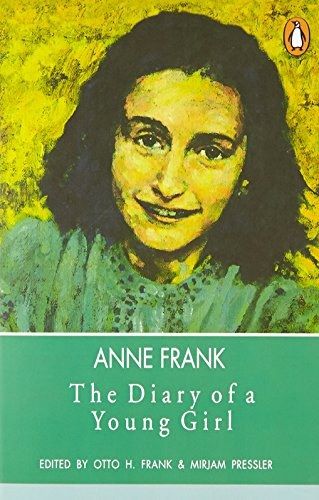
The Diary of a Young Girl
Anne Frank · 1947
She heard a radio broadcast asking Dutch people to save their wartime writing — and spent her last months in hiding rewriting her own diary into a book.
A notebook for a thirteenth birthday
Anne Frank was given a red-and-white checked autograph book for her thirteenth birthday, on 12 June 1942. She used it as a diary. Less than a month later, on 6 July, her family went into hiding in a concealed set of rooms behind her father's business premises on the Prinsengracht in Amsterdam.
Eight people lived there for just over two years, in silence during working hours, dependent on a small number of employees who knew and said nothing. She was thirteen when she went in and fifteen when she was arrested.
The broadcast that changed the diary
This is the part most people don't know, and it changes how the book should be read.
On 28 March 1944, the people in the annex listened to Radio Oranje, broadcast from London. A Dutch government minister in exile, Gerrit Bolkestein, made an appeal: after the war, ordinary Dutch people's diaries and letters would be needed as evidence of what the occupation had actually been.
Anne already wanted to be a writer. She took the appeal personally and seriously. On 20 May 1944 she began rewriting her own diary into a book, which she planned to call Het Achterhuis — "the annex", or "the house behind".
She was not simply keeping a diary any more. She was editing one. She cut passages, rewrote others, invented pseudonyms for the people around her, and added new material. In a few months she produced roughly 50,000 words on more than 215 loose sheets of paper, covering the period from June 1942 to March 1944.
She was fifteen, in hiding, revising her own life's manuscript for a public that didn't yet exist.
4 August 1944
The annex was raided on 4 August 1944. The eight people hiding there were arrested and deported. Anne and her sister Margot were eventually sent to Bergen-Belsen, where both died of typhus in early 1945, within weeks of the camp's liberation. Of the eight, only her father Otto survived.
After the arrest, Miep Gies — one of the employees who had kept them alive for two years — gathered up Anne's papers from the floor of the ransacked annex and put them away in a desk drawer, unread. She has said that had she read them, she would have had to destroy them, because they named the people helping and would have condemned them.
She kept them for a year, waiting to give them back to Anne. When it was confirmed that Anne was dead, she gave them to Otto.
The book
Otto Frank prepared a text from both versions — the original diary and Anne's own edit — and Het Achterhuis was published in June 1947 in an edition of 3,036 copies.
It has since been translated into more than seventy languages and is among the most widely read books in the world.
On screen and on stage
A Broadway play followed in 1955 and won the Pulitzer Prize for Drama. The 1959 film won three Academy Awards. There have been television adaptations, an animated feature, and a graphic adaptation authorised by the Anne Frank Fonds.
They have also been argued about continuously, mostly over the same thing: whether adaptations soften the ending to leave audiences with hope, when the actual ending is that she was murdered at fifteen along with almost everyone else in the annex.
Why it still matters
The diary is often described as a book about hope. It is more accurate to say it is a book by a writer — impatient, funny, sharply critical of the adults around her, frequently unkind about her mother, and getting steadily better at her craft in real time.
That is what makes it unbearable rather than merely sad. You can watch someone become a writer across two hundred pages, knowing what is on the last one.
Did you know
- The diary began as a thirteenth-birthday present, three weeks before the family went into hiding.
- A radio appeal on 28 March 1944 by an exiled Dutch minister is why she started rewriting it as a book.
- She rewrote around 50,000 words onto 215+ loose sheets in a few months.
- Miep Gies saved the papers without reading them — she has said that if she had, she would have burned them to protect the people named.
- The first edition, June 1947, was 3,036 copies.
- The stage version won the Pulitzer Prize for Drama in 1956.
Is this book on a shelf near you?
BookHome is a neighbourhood book exchange. See who nearby has a copy to lend, swap or sell.