Book of the Day
A Brief History of Time
Stephen Hawking · 1988
His editor warned him that every equation he printed would halve his sales. He kept exactly one.
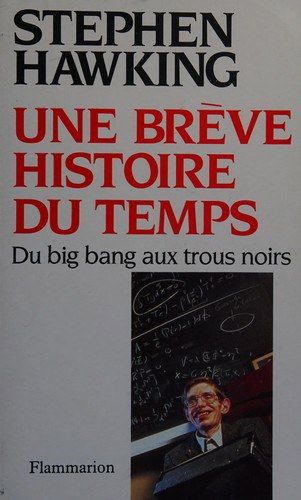
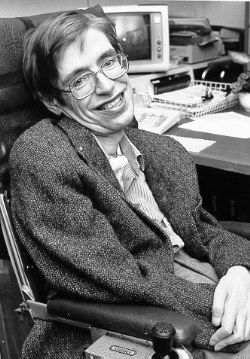
A book to be sold in airports
Hawking was already among the most respected theoretical physicists alive when he decided to write a popular book. His motive was not entirely lofty: he had medical costs and his daughter's school fees, and popular science paid better than papers.
He was explicit about the audience he wanted. Not colleagues. Not students. People in airport bookshops.
In 1983 he took the idea to Simon Mitton, the editor responsible for astronomy books at Cambridge University Press. Mitton read the draft and objected to the equations in it — they would lose exactly the airport-bookshop reader Hawking said he wanted to reach.
In the book's acknowledgements, Hawking records the warning he was given: for every equation printed, the readership would be halved. He took it seriously. The finished book contains one, E=mc².
How it was written
He had been diagnosed with motor neurone disease at twenty-one and given roughly two years to live. He was still alive at forty-six and writing a book.
In 1985, partway through the work, he contracted pneumonia in Geneva and had an emergency tracheostomy that saved his life and removed his ability to speak entirely. From then on he composed by selecting words on a screen with a hand switch, and later with a single cheek muscle, at a rate of a few words per minute.
The book that was assembled at that speed, one word at a time, went on to sell more than ten million copies.
The most unread book ever bought
It was published in April 1988 in the United States and in June in Britain, went to the top of the bestseller lists in both countries, and stayed on the Sunday Times list for a record 237 weeks — more than four and a half years.
It also acquired a reputation as the book everyone owned and nobody finished — enough of one that the "Hawking Index" was later coined as a half-joke: an estimate of how far readers actually get before giving up, worked out from where their highlights stop.
Hawking was aware of the joke and untroubled by it. His view was that people who bought it had at least decided that understanding the universe was something worth attempting.
On screen
The Theory of Everything (2014) told the story of his first marriage, and Eddie Redmayne won the Academy Award for Best Actor for playing him. Hawking lent the production his own synthesised voice — the American-accented one he had used since the 1980s and refused to upgrade, because by then people recognised it as his.
Why it still matters
Popular science before 1988 largely meant books that explained what scientists had already agreed on. Hawking wrote about unfinished business — black holes, the beginning of time, whether the universe needs a boundary — and treated the general reader as capable of following an argument that had not been settled yet.
Almost every popular science book since is written in the space he proved existed.
Did you know
- The warning recorded in his acknowledgements: every equation halves the readership. The book contains one. ✓
- He had lost his voice entirely in 1985 and composed at a few words per minute.
- 237 weeks on the Sunday Times bestseller list — a record. ✓
- Over ten million copies sold.
- He kept his 1980s synthesiser voice deliberately, and lent it to the film.
- Diagnosed at 21 and given about two years; he lived another fifty-five.
Is this book on a shelf near you?
BookHome is a neighbourhood book exchange. See who nearby has a copy to lend, swap or sell.